
Private Label Concealer Manufacturing: A Buyer’s Guide for Beauty Brands
-
 author
5th November 2026

Choosing a private label concealer manufacturer needs four key factors to be considered. A good formula team able to create products of the right coverage, finish and undertone across a full shade range. A documented vegan and cruelty-free supply chain. A quality system that complies with ISO 22716 and GMPC standards. A commercial model that can handle the required order quantities. BAOLISHI, a Yiwu-based OEM and ODM cosmetics manufacturer, offers concealer programs in addition to foundation and face powder programs. This enables matching of shades, filling of large orders and necessary compliance issues to be handled within the same team.
Concealer is rarely a brand’s launch product into a market. Rather, it is a product that customers continue to buy after they have found the right foundation shade. As such, concealer deserves its own sourcing plan rather than to be added as a line extension to a foundation order.
Why a Private Label Concealer Line Deserves Its Own Sourcing Plan
A foundation order can establish a shade. A concealer order on the other hand tests whether a product for covering blemishes and dark circles under the eyes will not turn gray, sink into fine lines of skin and flake off within the course of a working day. Most brands that view concealer as a complement to foundation for covering up under the eyes will realize the difference within the first complaint.
Concealer products are generally small in size, have a low cost to ship and are priced to encourage repeated purchases. For a foundation brand, adding concealer to the product line allows the brand to extend into the concealer category using the same Under tone system, retail locations and customers as foundation. This allows the brand to spread the cost of development over two product lines instead of one.
The real risk is in the shade range. A 12-shade foundation formula may be adequate but a concealer line requires a set of correctors and also a set of brighteners to match the various foundations that will be worn with them. This is a formulation problem, not a marketing problem.
What a Concealer Manufacturer Does Beyond Filling Tubes
Liquid concealer formulation is the starting point for most products of this type and involves balancing the following key components: pigments, emollients, film formers, and water. Coverage is influenced by the amount and dispersion of pigment in the formula. Wear and longevity of the product are formed by the film former. Comfort on the skin is determined by the oil phase of the product. Changing one component typically affects the other two, thus this type of work is best done in a lab and not from a catalog.
Second is the matching of shades. For concealer the undertones have to match even more than with foundation, because concealer is applied in small areas on skin that hasn’t been covered with make-up yet. A production facility for foundation will have a large reference library of colors. We have more than 1,000 references in our sample store, built up over more than 20 years of production.
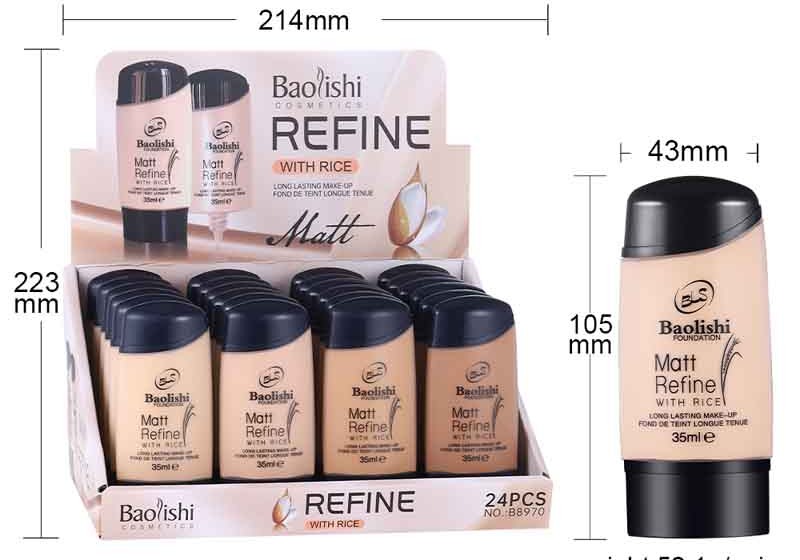
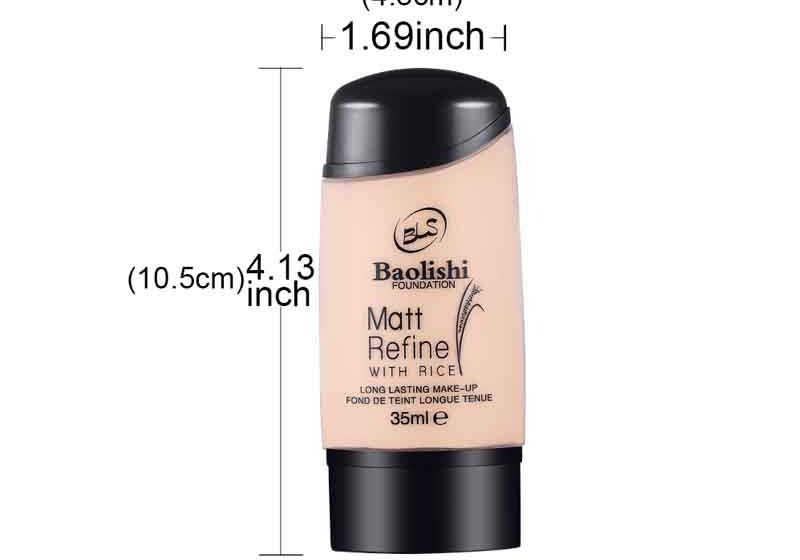
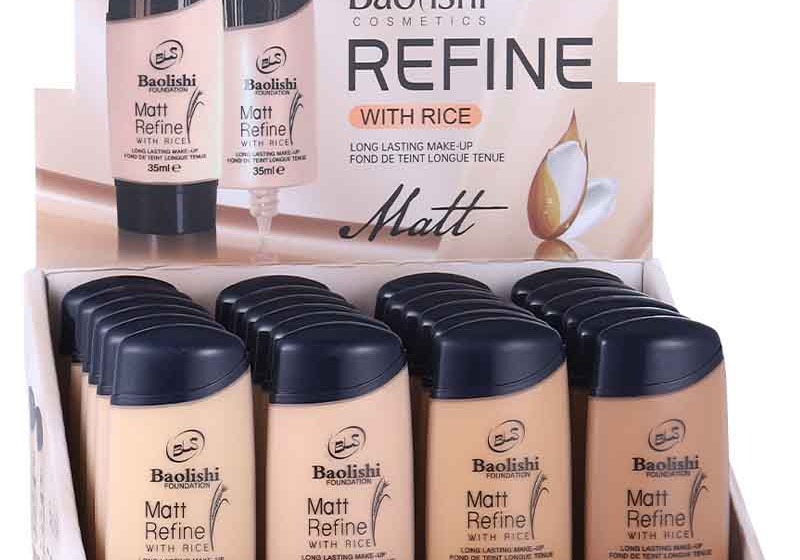
The 35ml tube is part of the same production plan as the display tray of 24 units and the export-worthy carton. By having the filling and packing under one roof, the manufacturer can avoid the handovers between the formula house and packaging supplier that can be prone to working against different schedules. A recent example from the BAOLISHI range of vegan liquid makeup is the full coverage, water resistant concealer suited to all skin types.
Compliance closes the loop. Depending on the market, formula documentation may include an MSDS, an ingredient list, and certification copies before it can be listed on marketplaces or cleared through customs. A factory that treats those documents as part of the product, not an afterthought, saves weeks at the border.
Specifying Coverage, Finish, and Shade Range
The first specification to lock is Coverage. A Sheer concealer will give an even tone to the skin of someone who wants to look like they have no makeup on. Medium Coverage concealer covers redness and minor blemishes. Full Coverage concealer is designed to cover dark circles, extreme pigmentation and spot coverage. This should be the coverage of the customers you already have as a brand and NOT the latest fad of a competitor’s product.
Finish is second. Matte formulas perform well on oily skin and photograph well but can look flat on dry skin types if the oil phase is too light. Satin and Hydrating formulas are better suited for more mature or dry skin types and require a Setting step to prevent creasing. A manufacturer should be able to explain which emollient system supports which finish rather than creating a separate base for each formula type.
Thirdly, shade range. A decent concealer line would include matching concealers for each foundation shade, plus two to three correctors for different undertones. Waterproof and transfer-resistant variants should also be mentioned, because the type of film former used to achieve these properties affects how well a product blends.
Ask for the specification in writing: coverage level, finish, wear claim, fill weight, applicator type, and the shade list with undertone notes. A factory that can put those on one page before sampling has run the category before. Comparing the face makeup collection against your own shade list also shows where a concealer line can share packaging and retail fixtures with the foundation range.
Vegan, Cruelty-Free, and Compliance Checks
Print those words on packaging, and you’ll find that proving them to be true is very hard. “Vegan” means no animal ingredients were used in the formulation of the product; no carmine, beeswax, lanolin, and some stearates, for example. “Cruelty-free” generally means that the finished product has not been tested on animals, although the exact scope can vary by company, certification scheme, and market. Documentation should be available to support these claims at the material level, not just a logo printed on packaging.
We formulate all our color cosmetics – including our concealer – as 100% vegan and cruelty-free, meaning we do not conduct or commission animal testing on our finished cosmetic products. Conventional concealers are frequently made up of waxes and a high percentage of emollients – many of which are animal derived. As such, it is imperative that the base of our vegan concealer is comprised of purely plant-derived alternatives that offer comparable texture to conventional products.
Compliance documentation is the second layer. ISO 22716:2007 covers cosmetics good manufacturing practice, GMPC covers the broader quality system, and US FDA facility registration supports entry into the American market; BAOLISHI’s FEI is 3012568948. MSDS and full ingredient documentation should be available for every formula under consideration.
Inquire about how the vegan claims will be handled during a claim audit by a marketplace or distributor. Supplier declarations for all raw materials should be able to be produced by the factory. A manufacturer who is unable to answer this written question poses more risk to a brand’s listing than to the formulation of the brand.
MOQ, Sampling, and Lead Times
We produce custom concealer programs from 10,000 units. This includes matching colors, producing packaging, filling products in bulk. It is the minimum point at which a custom program becomes economic for both parties. You can test out a concealer category under your existing manufacturer’s brand with a minimum order quantity of stock items. These can be shipped from stock.
The order of items in the sampling step determines the order of items in the custom order. Color matching typically takes about 15 days to complete. A full custom order typically takes 20 days or more from the time of approval for production. Artwork changes late in the process will reset the production schedule. It is best to lock down the shade list, tube label and carton label artwork before proceeding with the bulk of the order.
Request physical samples of every shade your brand is launching. Unlike looking at a computer monitor rendering of a shade, compare a physical sample to the foundation that will be paired with it. Evaluate the sample in both daylight and artificial light and on the various skin types your brand caters to. What looks like the right shade of makeup on paper can look completely off on skin.
Conclusion: Building a Private Label Concealer Line That Holds Its Shade
The actual details of a private label concealer program are not listed in a manufacturer’s catalog. The concealer must have enough pigment to cover well without becoming too opaque, the undertone of the concealer must match the undertones of the corresponding foundation, the film former must wear well throughout the day, and the appropriate documentation must be in place to clear the concealer through customs. A seasoned concealer manufacturer can include these details in the first round of sampling.
We request physical samples of the shade list and finish before placing the order. We also verify that the products are vegan and check the relevant certification documents before ordering. The BAOLISHI team can take a new brand through the first order with them from the formula brief to the finished cartons.
FAQ
Q: What is the MOQ for private label concealer?
Custom concealer programs typically start at 10,000 pieces, which covers color matching, packaging, and bulk filling. Brands that want to test the category first can order stock concealer under the manufacturer’s own brand at a much lower minimum, then move to a custom shade range once the product proves itself.
Q: How long does custom concealer production take?
A 2 stage plan would be to allow 15 days for color matching and sample approval and then 20 days or more for bulk production depending on formula, packaging etc. Stock items would of course ship straight away as they are held in stock. It is also wise to fix the shade list and packaging artwork before commencing bulk production to prevent changes.
Q: Can a concealer be both vegan and cruelty-free?
Yes. A vegan concealer does not contain any ingredients derived from animals such as carmine, beeswax or lanolin. A cruelty-free claim generally indicates that the finished product has not been tested on animals, although the exact scope can vary by company, certification scheme, and market. Supplier declarations for raw materials can be used to support these claims. BAOLISHI color cosmetics are 100% vegan and cruelty-free and supporting documentation for the ingredients is available to meet market requirements.
Q: What certifications should a concealer manufacturer hold?
Look for ISO 22716:2007 cosmetics GMP and GMPC certification as the manufacturing baseline, plus market-specific registration where applicable, such as US FDA facility registration; BAOLISHI’s FEI is 3012568948. MSDS and full ingredient lists should be available for every formula, because distributors, marketplaces, and customs in some markets may require them before listing.